
Running a window cleaning business means juggling recurring routes, weather reschedules, short back-to-back jobs, and customers who expect a reminder text and a tap-to-pay invoice. The right software handles all of that; the wrong one becomes another app your crew ignores.
Most "best window cleaning software" lists are affiliate pages ranking whoever pays the highest commission. This one is different: we build one of these tools, we say so up front, and we tell you where each competitor genuinely beats ours.
New to the category? Start with what window cleaning business software is and the features that actually matter. This guide is for choosing between the options.
How we evaluated
Window cleaning has four make-or-break requirements, and every tool below was judged on them: recurring route handling (the same storefronts, every two weeks, without re-entry), rain-day rescheduling speed (one drag should move the afternoon and notify everyone), photo documentation (before/after proof attached to every property), and on-site payment (invoice sent and paid before the ladder is back on the van). Plus the universal test: true monthly cost at your real crew size. Pricing claims were checked against each vendor's public pricing page on the date above.
The comparison
1. Cleri
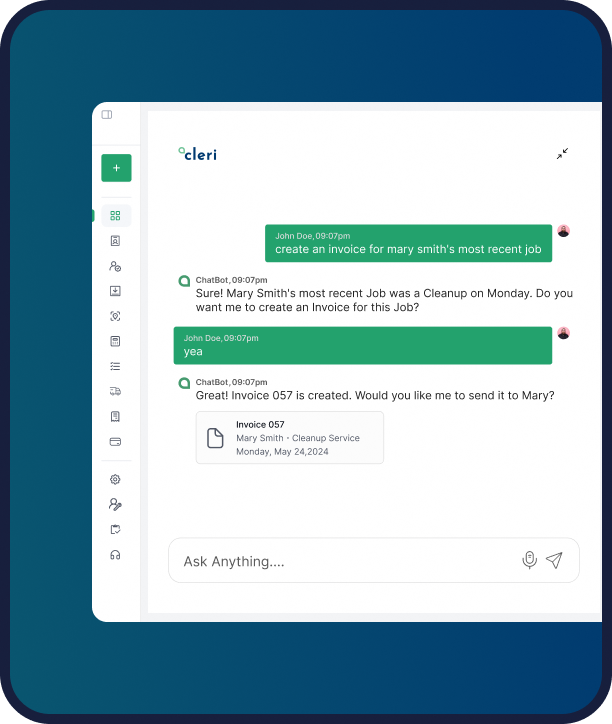
Cleri is an all-in-one field service platform built for blue-collar trades, with one feature no competitor here has: Cleo, a voice-powered AI assistant. Speak from the route ("move Mrs. Park to Friday morning and send today's invoices") and it is done, no typing between jobs.
For window cleaning specifically: recurring job templates fill the season's calendar automatically, drag-and-drop rescheduling notifies crews and customers at once, before/after photos attach to each property's record, and invoices trigger on job completion with tap-to-pay links.
Pricing: flat $100/month including one user, plus $20/month per additional active user. Every feature included, no tiers, and inactive seasonal users cost nothing, which matters when half the crew goes home for winter.
Where it wins: total cost at crew scale, seasonal billing, voice-driven admin, and zero feature paywalls.
Where it falls short: newer brand than the incumbents, and no built-in consumer marketplace feeding you leads.
2. Squeegee
Squeegee is the window-cleaning specialist of this list, built specifically for round-based cleaning work. Its round scheduling (the recurring route logic UK window cleaners call "rounds") is genuinely deep: debt tracking per customer, round balancing, and payment collection built around repeat domestic work.
Pricing: free tier for small rounds, paid tiers per user for advanced features.
Where it wins: solo and small domestic window cleaners who think in rounds, and the free tier is real.
Where it falls short: it is round-cleaning-shaped; crews mixing in pressure washing, gutters, or commercial contract work outgrow its model, and the broader business features (deep reporting, dispatch) run lighter than general FSM platforms.
3. Jobber
Jobber is the most popular general home-services entry point: polished interface, fast setup, and the broadest integration ecosystem (QuickBooks, Zapier, and dozens more). Quoting, invoicing, and the client hub are all solid.
Pricing: per-user tiers; entry plans are affordable solo, and costs climb steeply as the crew grows, with automations gated to higher tiers.
Where it wins: ease of use and brand trust for small teams starting out.
Where it falls short: it is built for home services generally, not route-based repeat work specifically, and the pricing curve punishes growth.
4. Housecall Pro
Housecall Pro leans into the consumer-facing side: online booking, automated review requests, "on my way" texts, and consumer financing. For residential window cleaners whose growth runs on Google reviews, that focus pays off.
Pricing: per-user tiers, strongest features in higher plans.
Where it wins: reputation building and residential customer experience.
Where it falls short: the single-visit job model fits recurring commercial contracts less naturally, and per-user pricing scales the same way Jobber's does.
5. Workiz
Workiz is built around a live dispatch board with a built-in phone system and call tracking, designed for high-call-volume urban service businesses.
Pricing: per-user tiers.
Where it wins: operations that live on inbound calls and same-day dispatch.
Where it falls short: window cleaning runs on recurring routes more than inbound calls, so Workiz's core strength maps to this trade less directly, and reporting runs lighter than the bigger platforms.
6. ServiceTitan
ServiceTitan is the enterprise platform of the category: the deepest reporting, marketing attribution, memberships, and payroll in field service. Large multi-crew commercial window cleaning operations that fully implement it get visibility nothing else matches.
Pricing: custom quotes, typically the most expensive option, with onboarding measured in months.
Where it wins: operations past roughly 10 crews with complex commercial contracts and a manager to own the system.
Where it falls short: cost and complexity are genuine overkill for the small crews that make up most of this industry.
“All my time is spent in the dirt, and it’s tough to stay on top of everything. Thankfully there’s Cleri. It made the hardest parts of owning a business easy, and that’s something I can stand behind.”
Brad, Seasons Irrigation
Honest calls
Solo domestic cleaner working rounds: Squeegee's free tier is the honest starting point. Small mixed-services crew wanting polish and integrations: Jobber. Residential and review-driven: Housecall Pro. Large commercial operation: ServiceTitan, if you will implement it properly. Where Cleri wins is the working middle: flat pricing that does not punish adding crew, winter-friendly billing, every feature from day one, and voice admin nobody else has.
Which one fits your situation
Solo, under 40 customers: Squeegee free, or Cleri's base plan if you want voice admin and room to add services. 2 to 5 crew members: run the per-user math on Jobber or Housecall Pro against Cleri's flat rate at your headcount; the gap widens with every hire. Seasonal operation: weight winter costs heavily; Cleri's inactive-user rule usually wins this math. Commercial contracts and 10+ crews: demo ServiceTitan and budget for onboarding.
Is there a fully free option beyond Squeegee's tier? A few, with real limits; see free software for window cleaning businesses for the honest rundown.
FAQs
Q 1. What is the best window cleaning software overall?
There is a best fit per situation, not one winner. Rounds-based solo: Squeegee. General small crew: Jobber or Cleri. Reviews-driven residential: Housecall Pro. Enterprise: ServiceTitan.
Q 2. How much does window cleaning software cost?
Free tiers exist for solo rounds; paid tools run roughly $30 to $150+ per user per month on tiers. Cleri is flat: $100/month including one user, plus $20 per active user, all features included. Compare annual cost at your summer headcount minus winter.
Q 3. Do these tools handle recurring commercial contracts?
Cleri, Jobber, and ServiceTitan handle recurring commercial billing well. Squeegee is domestic-round-shaped, and Housecall Pro fits single-visit work best. Test per-site billing during any trial if commercial is your mix.
Q 4. What about CRM and customer records?
All six keep customer records; the depth varies. For what a window-cleaning CRM should include, see our guide to window cleaning management software and CRM.
The bottom line
Pick by how your work actually runs: rounds, mixed services, residential reviews, or commercial contracts. Verify pricing at your real crew size, and make the crew test the mobile app on a real route before committing. The full toolkit behind our pick lives in window cleaning business software.
About the author
By Moqudas Azam, Head of Content at Cleri, with 6 years of experience working with field service teams. Reviewed by Brandon Parham, industry expert. Published August 5, 2025 · Last updated July 25, 2026.
Related Articles

Best Lawn Care Software Compared: 8 Tools Reviewed (2026)
There are more lawn care software options than...
.webp)
Best Field Service Management Software: 8 Tools (2026)
Field service management software runs the...

What Is Window Cleaning Business Software & Who Needs It?
Picture the real morning rush.
It’s 5:30 a.m. You...

How Window Cleaning Software Improves Customer Retention
How window cleaning software helps with customer...

How to choose the right software for your window cleaning company
Still using paper schedules, texting your crew...
10 Tech Advantages for Window Cleaning Success
10 proven advantages of using technology to...
.webp)
SaaS vs On-Premise for Window Cleaning Businesses
SaaS vs. On-Premise: What's Better for Window...

Window Cleaning Software Trends 2026 | AI & Growth
Industry trends in window cleaning software in...

Lawn Care Accounting Software for Smarter Job Costs & Faster Billing
Streamline your business with lawn care...

Benefits of Field Service Management Software: 2026 Guide
Still chasing payments and drowning in admin? See...

12 Window Cleaning Software Mistakes to Avoid
Common mistakes businesses make when choosing...
Window Cleaning Management Software & CRM: A Complete Guide
How Window Cleaning Software Saves Time and...
.png "Frame 1984078137 (1)")
Try Cleri’s 14-day free trial and
see for yourself
No credit card. No setup calls. Just your real jobs, your real crew, and a
smoother, more predictable week.
