
Field service management software runs the business side of trade work: scheduling, dispatch, customer records, invoicing, and payments in one system instead of five disconnected apps.
The category has a dozen serious players, and most "best of" lists are written by affiliates ranking whoever pays the highest commission. This one is different: we build one of these tools, we say so up front, and we tell you where each competitor genuinely beats ours.
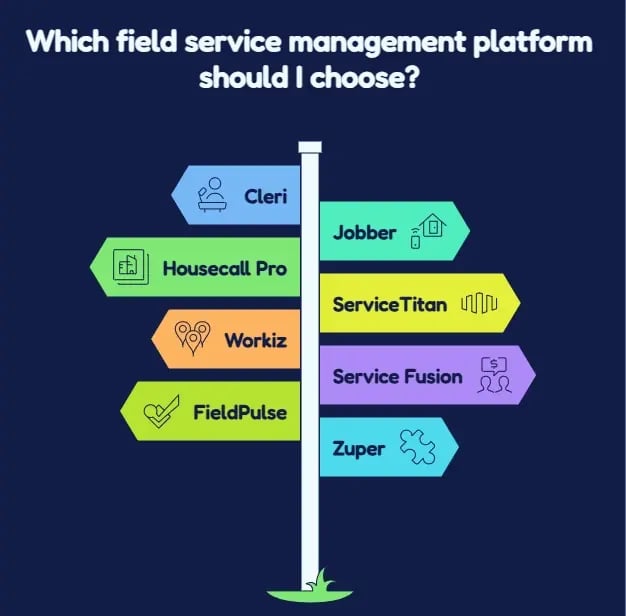
The short version: there is no single best tool, only a best fit for your team size, trade, and budget. Solo operators on a budget usually land on Jobber or FieldPulse. Large commercial operations get real value from ServiceTitan. Small and mid-size crews that want flat pricing, every feature included, and voice-driven admin are exactly who we built Cleri for. The full breakdown of all eight is below.
What field service management software should include
Before comparing brands, know the baseline. Any serious FSM platform in 2026 should cover:
- Drag-and-drop scheduling with recurring job support
- Dispatch with crew assignment and route ordering
- A customer database with full job history and site notes
- Estimates that convert to jobs and invoices without retyping
- A mobile app where crews see jobs, upload photos, and mark work complete
- Payment collection in the field by card or ACH
- Basic reporting on jobs, revenue, and crew performance
Treat those as table stakes. The differences that actually decide the choice are pricing model, trade-specific depth, offline capability, and how fast the day can be rearranged when weather or a callout breaks the schedule.
How we evaluated
Five things decide whether FSM software survives real field use:
- Scheduling speed when the day changes: weather, callouts, emergencies
- Crew adoption: does the mobile app work one-handed, in the sun, offline
- Time from job-done to invoice-sent
- True monthly cost at your real headcount, including the features you actually need
- Whether those features are included or locked behind higher tiers
Pricing claims below were checked against each vendor's public pricing page on the date above.
The comparison
1. Cleri
Cleri is an all-in-one field service platform built specifically for blue-collar trades, with one feature no competitor has: Cleo, a voice-powered AI assistant. Speak from the truck ("book Mrs. Davis for Tuesday morning, send the quote for the water heater install") and the scheduling, quoting, or invoicing is done. No typing, no menus.
Beyond voice, the platform covers scheduling and dispatch, route optimization, CRM with full job history, estimates, inventory and material tracking, a crew mobile app with offline mode, and invoicing with card and ACH payments through Stripe at standard rates with no markup.
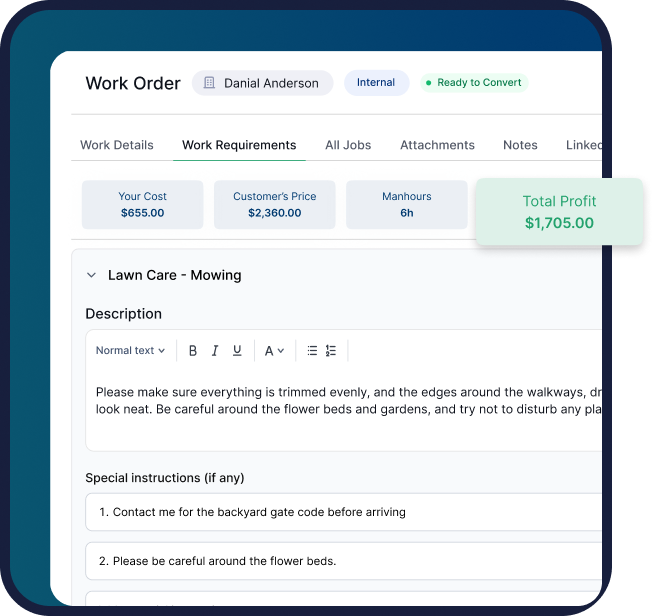
Pricing: flat $100/month including one user, plus $20/month per additional active user. Every feature included from day one, no tiers. Users who do not log in during a month cost nothing, which matters for seasonal trades.
Where it wins: total cost at crew scale, hands-free admin, seasonal billing, and no feature paywalls.
Where it falls short: newer brand with a smaller track record than the incumbents, no consumer marketplace to feed you leads, and no satellite property measurement.
“All my time is spent in the dirt, and it’s tough to stay on top of everything. Thankfully there’s Cleri. It made the hardest parts of owning a business easy, and that’s something I can stand behind.”
Brad, Seasons Irrigation
2. FieldPulse
FieldPulse is the value pick: a genuinely broad feature set covering scheduling, CRM, estimates with good/better/best options, timesheets, and pricebook support, at lower per-user prices than the big names, with customer support that reviewers consistently rate among the best in the category.
Pricing: per-user, below most competitors at equivalent feature levels.
Where it wins: growing trade businesses that want 90% of the big-platform feature set without the big-platform bill.
Where it falls short: smaller integration ecosystem, smaller community, and fewer trade-specific depth features than the specialists.
3. Jobber
Jobber is the most popular entry point in home services, and for good reason: the interface is genuinely polished, setup is fast, and the integration ecosystem (QuickBooks, Zapier, Mailchimp, and dozens more) is the broadest in the category. Scheduling, quoting, invoicing, and client hub features are all solid, and the client-facing experience with online booking and automated follow-ups is among the best.
Pricing: per-user plans across multiple tiers. Entry tiers are affordable for solo operators; costs climb steeply as you add users, and key features like automations and advanced reporting sit in the higher tiers.
Where it wins: ease of use, integrations, and brand trust for small teams starting out.
Where it falls short: the pricing curve punishes growth, it is built for home services generally rather than any specific trade, and feature gating means the tool you demo is not always the tier you can afford.
4. Housecall Pro
Housecall Pro leans hard into the consumer-facing side of home services: online booking, automated review requests, "on my way" texts, and consumer financing options for big-ticket jobs. For businesses whose growth depends on Google reviews and residential customer experience, that focus pays off.
Pricing: per-user tiers, with the strongest features like advanced reporting and recurring service plans in higher plans.
Where it wins: reputation building, residential customer experience, and financing for large installs.
Where it falls short: the single-visit residential job model fits recurring commercial contract work less naturally, and per-user pricing has the same scaling problem as Jobber.
5. ServiceTitan
ServiceTitan is the enterprise standard for HVAC, plumbing, and electrical companies, and its depth is real: call recording tied to bookings, technician scorecards, marketing attribution, memberships, payroll, and the strongest reporting suite in the category. Large operations that fully implement it get visibility nothing else matches.
Pricing: custom quotes only, typically the most expensive option in the category, with meaningful onboarding fees and setup timelines measured in months.
Where it wins: operations past roughly 10 technicians with complex commercial work and a manager who will own the system.
Where it falls short: cost and complexity are genuine overkill for small crews, pricing is not public (ask for the full picture including onboarding), and switching away later is a project.
6. Workiz
Workiz is built around the dispatch board: a live view of jobs, techs, and territories that urban, high-call-volume businesses like locksmiths, appliance repair, and junk removal run their whole day from. The built-in phone system with call tracking and recording is a differentiator; you see which ad campaigns actually ring the phone.
Pricing: per-user tiers.
Where it wins: dispatch-heavy operations and businesses that live on inbound calls.
Where it falls short: inventory management and reporting run lighter than the bigger platforms, and trades built on recurring routes like lawn, pool, and cleaning fit its call-driven model less well.
7. Service Fusion
Service Fusion offers most of the core FSM feature set (scheduling, dispatch, GPS fleet tracking, estimates, invoicing, QuickBooks sync) at flat-rate pricing tiers rather than per-user fees, which makes it one of the few incumbents where adding techs does not multiply the bill.
Pricing: flat tiers by feature level, unlimited users on each.
Where it wins: mid-size shops that want predictable costs and a full feature set without per-seat math.
Where it falls short: the interface shows its age, the mobile experience trails newer tools, and crews who compare it side by side with modern apps notice.
8. Zuper
Zuper targets the enterprise end from a different angle than ServiceTitan: API-first architecture, deeply customizable workflows, and integrations designed for companies with existing ops stacks (CRMs, ERPs, customer portals) that need field service to plug in rather than take over.
Pricing: custom quotes.
Where it wins: enterprises and franchises with ops teams who want to configure workflows precisely.
Where it falls short: that flexibility demands setup effort and technical ownership; owner-operators without an ops team will fight it.
Honest calls
Below 3 techs on a tight budget, Jobber's entry tier or FieldPulse likely fits best. Past 15 techs with complex commercial work, ServiceTitan's depth is worth its price if you will actually implement it. Flat-cost predictability with an older interface: Service Fusion. Where Cleri wins is the middle: flat pricing that does not punish growth, every feature from day one, seasonal-friendly billing, and voice-driven admin no competitor matches.
Which one fits your situation
Solo or 2 techs: entry tiers of Jobber or FieldPulse, or Cleri's base plan if you want voice admin and zero feature gates.
3 to 10 techs: this is where per-user pricing bites. Compare your exact headcount cost on Jobber against Cleri's flat rate; the gap surprises most owners.
Seasonal trades (lawn, snow, exterior work): weight winter costs heavily. Cleri's inactive-user rule, where off-season crew members cost nothing, usually wins this math.
10+ techs with commercial contracts: demo ServiceTitan and Zuper, and budget real time and money for onboarding either way.
Cloud vs on-premise, briefly
Every tool in this comparison is cloud-based, and that is not an accident: field crews need office and truck on the same live data, which installed single-computer software cannot do. The old on-premise trade-off of control versus sync is settled for mobile trades. If your crews work in offline spots like basements, rural routes, or parking garages, the question is not cloud versus installed, it is whether the app has a true offline mode that syncs later. Test that during any trial.
FAQs
Q 1. What is the best field service management software overall?
There is a best fit per situation, not one winner. Budget solo: Jobber or FieldPulse. Enterprise: ServiceTitan or Zuper. Flat-cost all-in-one with voice: Cleri.
Q 2. How much does field service management software cost?
Per-user tools run roughly $30 to $150+ per user per month depending on tier. Cleri is flat: $100/month including one user, plus $20 per active user, all features included. Compare annual cost at your peak headcount, not the sticker price.
Q 3. Is there free field service management software?
Free tiers exist and work for a handful of jobs a week. Routing, recurring billing, and dispatch, the features that add jobs to your day, are almost always paid.
Q 4. Can I switch tools without losing my customer data?
Yes. Every serious tool imports customer lists from spreadsheets or competitor exports. Cleri's AI import maps your data automatically. Run old and new in parallel for one week before cutting over.
Q 5. Does FSM software work for my specific trade?
The core is universal, but trade-specific depth varies. See our industry pages for what matters in your vertical: HVAC, plumbing, electrical, and lawn care.
The bottom line
Pick by team size and bottleneck, run the pricing math at your real headcount, and make the crew test the mobile app before committing. For head-to-head detail on how Cleri stacks against each tool, see Cleri vs Jobber, Cleri vs Housecall Pro, Cleri vs ServiceTitan, Cleri vs Workiz, and Cleri vs Service Fusion.
Want to see if the middle pick fits your crew?
No credit card. Import your real jobs and decide by Friday.
Reviewed by Brandon Parham, industry expert. Last updated August 2026.
Related Articles
Best Window Cleaning Software Compared: 6 Tools
Running a window cleaning business means juggling...

Best Lawn Care Software Compared: 8 Tools Reviewed (2026)
There are more lawn care software options than...

Benefits of Field Service Management Software: 2026 Guide
Still chasing payments and drowning in admin? See...

Field Service Automation: What It Handles & How It Works
Every field service business runs on the same...

9 Benefits of Cloud-Based Field Service Software (2026 Guide)
Field service businesses have a lot going on,...

Is there any free software for Window cleaning business?
If you're running a window cleaning business,...

Vibe Coded Field Service Software: Risks to Check First
Something new is happening in the field service...
HVAC CRM Software: Why Contractors Outgrow Generic CRMs
Most HVAC companies start with whatever CRM was...
10 Tech Advantages for Window Cleaning Success
10 proven advantages of using technology to...
.webp)
SaaS vs On-Premise for Window Cleaning Businesses
SaaS vs. On-Premise: What's Better for Window...

How Window Cleaning Software Improves Customer Retention
How window cleaning software helps with customer...

How to choose the right software for your window cleaning company
Still using paper schedules, texting your crew...
.png "Frame 1984078137 (1)")
Try Cleri’s 14-day free trial and
see for yourself
No credit card. No setup calls. Just your real jobs, your real crew, and a
smoother, more predictable week.
