
Most HVAC companies start with whatever CRM was free or already lying around. A spreadsheet. A generic sales CRM someone set up during a slow January. The contact list inside the accounting software. It works for the first year, sometimes two.
Then a customer calls in July, the office cannot see which system is in the house, the tech shows up with the wrong parts, and the maintenance agreement that would have made this a scheduled visit instead of an emergency was never tracked in the first place. That is the moment most owners go looking for CRM software for HVAC companies specifically, rather than a CRM that happens to store HVAC customers.
This guide covers what an HVAC CRM has to track that a generic one does not, the four points where contractors usually outgrow their current setup, what to look for, and an honest look at six options.
What an HVAC CRM has to track that a generic CRM does not
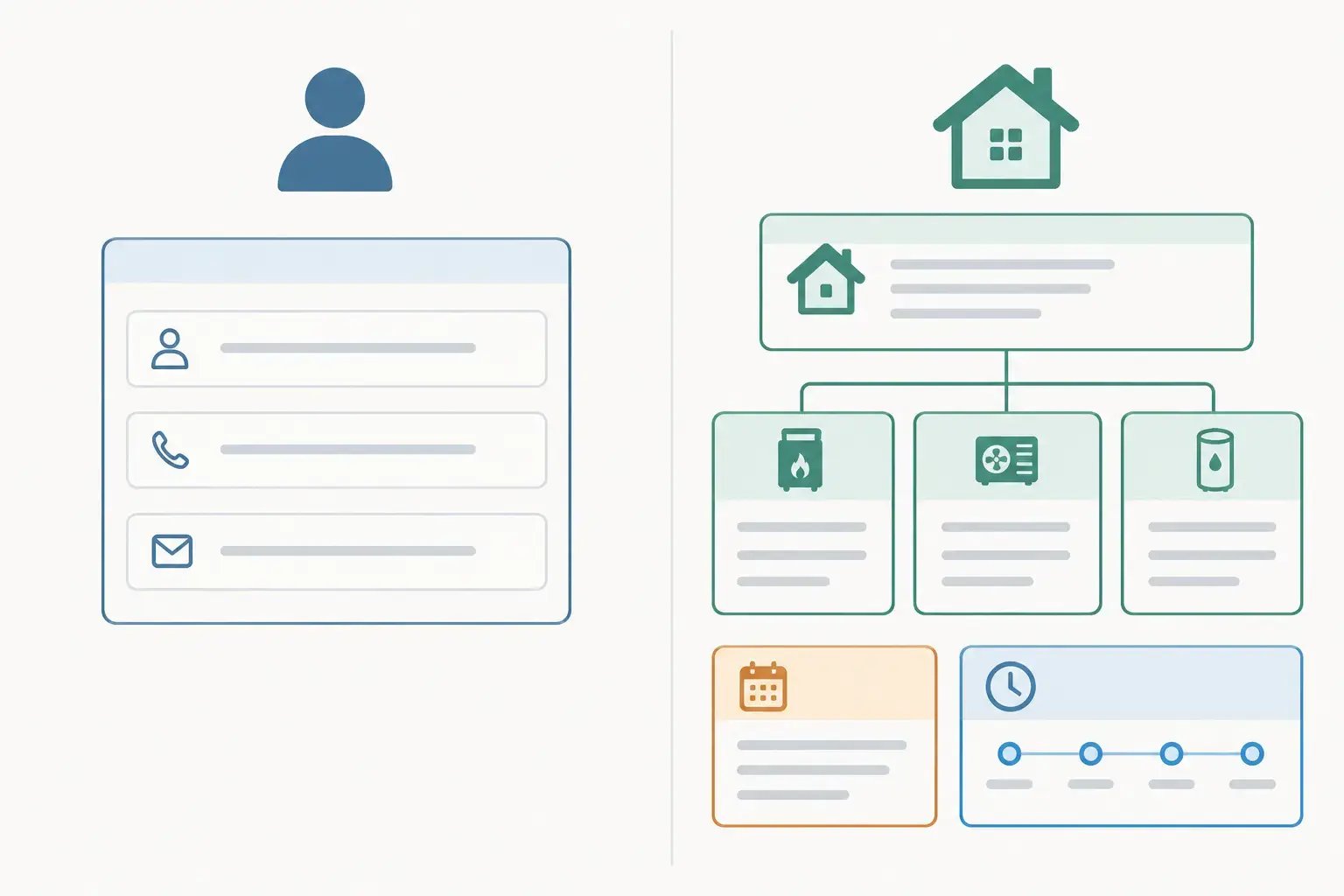
A generic CRM is built around a contact and a deal. An HVAC business is built around a property, the equipment inside it, and a relationship that repeats every season for fifteen years. Those are different data models, and the gap shows up in daily work.
Equipment, not just people. The customer is the house, and the house has a furnace, a condenser, maybe a heat pump and a water heater. Each has a make, model, serial number, install date, warranty window, refrigerant type, and filter size. When a tech is dispatched, that record is what they need before they knock. A generic CRM has nowhere to put it except a notes field.
Service agreements with renewal dates. Maintenance agreements are where HVAC margin and predictability live. Each one has a term, a visit schedule (usually spring and fall), a price, and a renewal date. The CRM has to surface who is due for a visit this month and who is up for renewal next month, without someone maintaining a separate spreadsheet.
Seasonal demand. Call volume in a heat wave looks nothing like call volume in October. The CRM has to handle a week where every lead is an emergency and the schedule is full by 9 a.m., then a month where the office is chasing renewals to fill the calendar.
The technician on the truck. In a generic CRM, the salesperson updates the record from a desk. In HVAC, the person who sees the equipment, talks to the homeowner, and finds the upsell is the tech standing in the basement. If the CRM does not work well on a phone, the record never gets updated.
Replacement quotes with financing. A repair call turns into a replacement conversation at the kitchen table. The CRM needs to attach a multi-option quote to the equipment record, track whether it was accepted, and follow up if it was not.
The four points where HVAC contractors outgrow a generic CRM
In our experience working with HVAC teams moving off spreadsheets and general-purpose CRMs, the break almost always happens at one of these four points.
1. The first peak season with more than two trucks. With one or two trucks, the owner holds the schedule in their head. Add a third and a dispatcher, and the CRM has to be the schedule, not sit next to it. Generic CRMs have calendars, but not dispatch boards that show who is where, what is on the truck, and which call is an agreement customer versus a new lead.
2. Service agreements pass fifty. Below that, a renewal spreadsheet is annoying but manageable. Above it, agreements start lapsing because nobody saw the date. Lapsed agreements are lost recurring revenue and lost off-season work in one hit.
3. The office and the field stop matching. The tech writes the serial number on a paper ticket. The office types it in two days later, or does not. By the second visit the record is wrong. This is where a mobile app that the tech actually uses stops being a nice-to-have.
4. Invoicing lives somewhere else. If the CRM tracks the customer but the invoice comes from accounting software, every job is entered twice, and the owner cannot see margin per job without exporting both and matching them by hand.
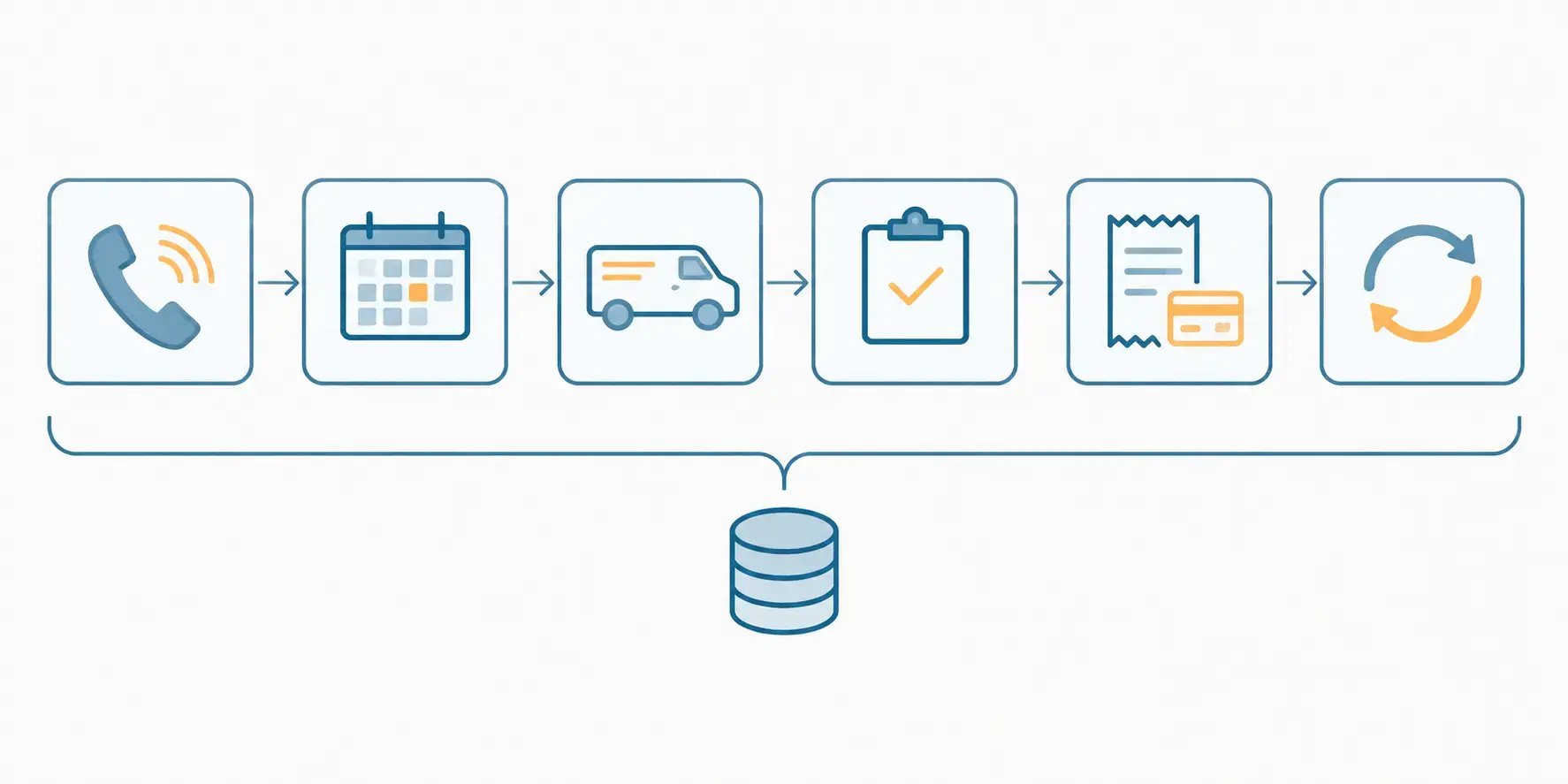
If one of those describes your business today, the fix is usually not a better generic CRM. It is field service management software that includes the CRM, the schedule, the equipment records, and the invoicing in one place.
What to look for in HVAC CRM software
Use this as a checklist when you trial anything. The items are in rough priority order for a shop with two to fifteen trucks.
- Equipment records tied to the property, with serial, model, install date, and warranty, visible to the tech before arrival
- Service agreement tracking with automatic reminders for due visits and upcoming renewals
- A dispatch board that shows the day by tech and by truck, with drag and drop
- A mobile app that works offline, because basements and mechanical rooms lose signal
- Quoting with multiple options so a replacement proposal can show good, better, best on one screen
- Invoicing and payment collection in the same system, so the tech can invoice and take a card on site
- Job costing that shows labour, parts, and margin per job without an export
- Automated follow-ups for unaccepted quotes, upcoming maintenance, and overdue invoices
- Pricing that does not punish seasonality, since HVAC headcount rises in summer and falls in winter
That last point gets missed. Most platforms bill per seat, every month, whether the seat is active or not. For a business that adds three techs in June and lets them go in September, that is nine months of paying for empty seats.
Six HVAC CRM options compared
Disclosure: Cleri is our product. We have tried to be straight about where each of these tools is stronger than ours, because a comparison where one option wins everything is not worth reading. Competitor pricing was verified September 3, 2026 from publicly listed plans. Check each vendor's site before you buy, since plans change.
HubSpot CRM (generic)
Best for: HVAC companies whose main problem is marketing and lead tracking, not field operations, and who already run dispatch elsewhere.
Standout strength: The free tier is genuinely useful for contact management, email, and pipeline. The marketing tools are far deeper than anything a field service platform offers.
Pricing model: Free starter CRM. Paid marketing, sales, and service hubs scale per seat and by contact count.
Watch out for: No equipment records, no service agreements, no dispatch board, no mobile invoicing. Every one of those becomes a custom object, a workaround, or a second tool. This is the setup most contractors are trying to leave.
Cleri
Best for: Shops of two to fifteen trucks that want the CRM, dispatch, equipment records, quoting, and invoicing in one flat-priced system, with a voice assistant for techs who would rather talk than type.
Standout strength: Cleo, the built-in voice assistant. A tech can log the serial number, add notes, create the follow-up quote, and send the invoice by speaking, which matters when hands are dirty or the phone is in a pocket. Offline mode holds the full job record, not just a cached view.
Pricing model: Flat. $100 per month including one user, plus $20 per month per active user. Anyone who does not log in during a month costs nothing, which suits seasonal crews. Card payments through Stripe at 2.9% plus $0.30, ACH at 1% capped at $10, no markup. 14 day free trial, no credit card. Full detail on the pricing page.
Watch out for: We are newer than Jobber, Housecall Pro, or ServiceTitan, so our third party integration library is smaller. If your business runs on a long tail of niche apps, confirm your specific tools are covered. A true solo operator will also find cheaper entry points elsewhere; the $100 base is built for teams.
Jobber
Best for: Established shops that want a mature platform with a large integration marketplace and a big community.
Standout strength: Breadth and polish. The client hub, quoting flow, and integrations are more developed than most competitors, and there is more third party training material than for anything else on this list. Jobber beats us on integrations outright.
Pricing model: Tiered, billed per user. Core starts at $39 per month for one user and plans run up to $599 per month for 15 users, with extra users at $29 per month and add-ons such as the AI receptionist billed separately.
Watch out for: Costs climb with headcount and there is no seasonal pause. Some automation and reporting features sit on higher tiers. Equipment tracking is present but lighter than the HVAC-specific platforms. Our Cleri vs Jobber comparison goes deeper.
Housecall Pro
Best for: Residential shops that lean on homeowner marketing, online booking, and consumer financing for replacements.
Standout strength: Customer facing tools. Online booking, review requests, and built-in consumer financing options are strong, and brand recognition among homeowners is high. On financing at the kitchen table, Housecall Pro beats us; we do not offer consumer financing.
Pricing model: Tiered. Basic starts at $59 per month on annual billing or $79 monthly for a single user. Essentials and MAX run higher, with MAX including up to eight users and additional users at $35 per month.
Watch out for: QuickBooks sync and GPS tracking are not on the Basic plan, which pushes most teams to Essentials. Payment processing rates vary by plan. See how Cleri compares to Housecall Pro.
ServiceTitan
Best for: Larger HVAC operations, typically twenty trucks and up, with a dedicated office team and the budget for an enterprise implementation.
Standout strength: Depth. Pricebook management, call recording tied to the customer record, marketing attribution, and reporting are the most complete in the category. For a large shop with a full back office, nothing else on this list matches it.
Pricing model: Quote based. ServiceTitan does not publish pricing; expect a sales process, an implementation fee, and contract terms.
Watch out for: The price and the onboarding effort are the reason a steady stream of mid-size contractors look for alternatives. The platform assumes an office team; owner-operators often find it heavier than the business needs. Our Cleri vs ServiceTitan page covers the trade-offs.
Workiz
Best for: Shops where missed calls are the biggest leak, and a built-in phone system with call tracking matters more than anything else.
Standout strength: The phone system and call handling. Inbound calls, recordings, and lead source tracking are tied to the customer record in a way most competitors do not match. If your problem is the phone, Workiz is stronger than we are here.
Pricing model: A free Lite tier capped at 20 jobs per month, then paid tiers in roughly the $190 to $325 per month range for small teams. The phone system and the Genius AI answering service are paid add-ons on top of the base plan.
Watch out for: The headline price does not include the features that differentiate Workiz. Extra users beyond the plan limit are billed per user. Plan names and prices have changed over time, so confirm on their site.
Does an HVAC CRM need a mobile app?
Yes, and it is the feature most likely to decide whether the CRM stays accurate.
The office does not see the equipment. The tech does. If updating the record means waiting until the truck is back in signal, or worse, until the end of the day, the record drifts out of date within a month. An HVAC CRM app should let the tech open the property record, see the last three visits and the agreement status, add the serial number, attach photos, build a quote, and invoice, all from the driveway, and all without a signal if the mechanical room is in a basement.
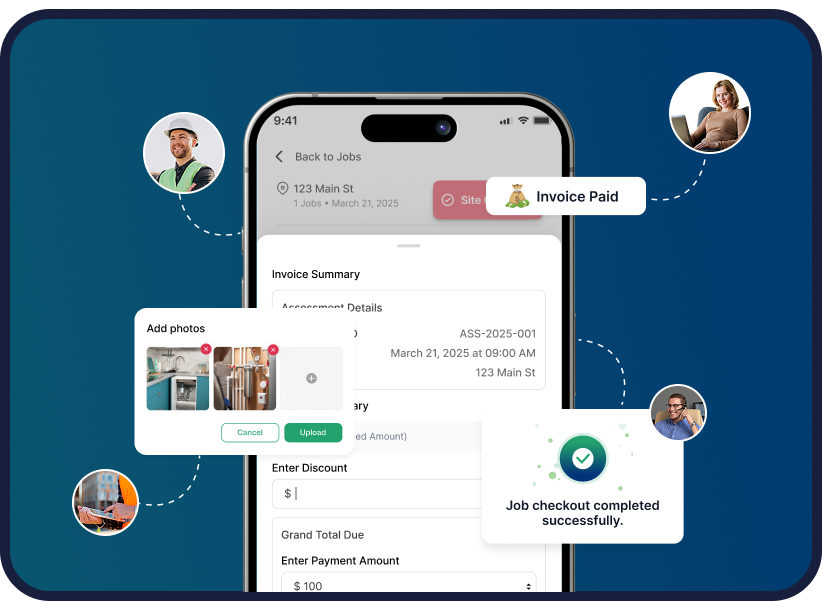
Voice input is the next step for the same reason. Typing a serial number on a phone with one hand while holding a flashlight is why records stay blank. Being able to read it aloud and have it land in the right field is the difference between a record that exists and one that does not.
What HVAC CRM software should cost
There are three pricing models in this category, and the model matters more than the sticker price for an HVAC business.
Per seat, every month. Jobber and Housecall Pro work this way. Simple to understand, but a seasonal shop pays for empty seats in the off season, and every feature tier adds cost.
Quote based. ServiceTitan. The number depends on your size and negotiation, usually with an implementation fee. Fine for large operations, a poor fit for anyone who wants to try before they commit.
Flat base plus active users. This is how Cleri prices, and it exists specifically because of HVAC seasonality. A base of $100 per month covers one user and every feature. Each additional user is $20 per month, but only in months they log in. Add three techs in June, let them go in September, and you pay for them for four months, not twelve.
Whichever model you choose, the line to check is payment processing. It is easy to compare a $79 plan to a $100 plan and miss that a half point difference in card processing on $600,000 of annual revenue is $3,000 a year.
Moving from a spreadsheet or generic CRM
The migration is usually smaller than owners expect. Four steps:
- Export your customer list as a CSV from wherever it lives. Name, address, phone, email is enough to start.
- Add equipment as you go. Do not try to backfill every serial number. Have techs capture equipment on the next visit to each property; within one maintenance season, most records are complete.
- Load service agreements first. These have dates attached and are the records that cost money when they lapse. Enter every active agreement with its renewal date before anything else.
- Run one full week in the new system before switching off the old one. Emergency calls included. If the tech can dispatch, quote, and invoice a real Tuesday without opening the old tool, you are done.
Cleri's import uses column mapping so the CSV does not have to match a template, and most teams are live within 30 minutes. If you want to see how the CRM sits inside the wider platform, the HVAC business management software page walks through scheduling, dispatch, and invoicing for HVAC specifically, and our guide to field service management platforms compares eight tools across trades.
Frequently asked questions
What is the difference between an HVAC CRM and a general CRM?
A general CRM is organised around contacts and sales deals. An HVAC CRM is organised around properties, the equipment inside them, service agreements with renewal dates, and the visit history, with a mobile app so the technician can update the record on site. Most HVAC companies that start on a general CRM move to a field service platform once agreements or truck count grow.
Do I need a CRM if I already use QuickBooks?
QuickBooks handles invoices and accounting well but has no equipment records, no scheduling, no dispatch, and no agreement tracking. Most HVAC CRMs sync with QuickBooks so invoicing flows through, while the operational record lives in the CRM.
Is there a free CRM for HVAC companies?
HubSpot's free CRM handles contacts and email but none of the HVAC-specific work. Workiz has a free Lite tier capped at 20 jobs per month, which suits evaluation but not a working business. Cleri offers a 14 day free trial with every feature unlocked and no credit card, rather than a permanent free tier.
How much does HVAC CRM software cost per month?
Entry prices range from $39 per month for a single user on Jobber's Core plan to quote-based pricing on ServiceTitan. Cleri is $100 per month including one user, plus $20 per month per active user. For a five-person shop, total cost on any platform usually lands between $150 and $400 per month once add-ons and processing fees are included.
Can a tech update the CRM offline?
It depends on the platform. Some apps show cached information offline but require a connection to create or edit records. Cleri's app lets techs create jobs, add equipment, log notes, and build quotes without a signal, then syncs when the connection returns.
Ready to try an HVAC CRM built for seasonal crews? Every feature is included, billing pauses for inactive users, and there is no credit card needed for the 14 day trial.
Related Articles

Why Lawn Care CRM Software Matters in 2026
Lawn care CRM software: Why 91% of growing teams...
Window Cleaning Management Software & CRM: A Complete Guide
How Window Cleaning Software Saves Time and...

Is there any free software for Window cleaning business?
If you're running a window cleaning business,...

Blue Collar Business Software: What Field Crews Need
Blue-collar businesses today need more than hard...
.webp)
SaaS vs On-Premise for Window Cleaning Businesses
SaaS vs. On-Premise: What's Better for Window...

Vibe Coded Field Service Software: Risks to Check First
Something new is happening in the field service...

Plumbing Job Management Software: What It Actually Runs
The call that breaks your day is never the...

9 Benefits of Cloud-Based Field Service Software (2026 Guide)
Field service businesses have a lot going on,...
12 Window Cleaning Software Mistakes to Avoid
Common mistakes businesses make when choosing...
Best Lawn Care Software Compared: 8 Tools Reviewed (2026)
There are more lawn care software options than...
What Is Window Cleaning Business Software & Who Needs It?
Picture the real morning rush.
It’s 5:30 a.m. You...

How Lawn Care Estimating Software Works (and Why Crews Use It)
Lawn care estimating & quoting software: The tool...
.png "Frame 1984078137 (1)")
Try Cleri’s 14-day free trial and
see for yourself
No credit card. No setup calls. Just your real jobs, your real crew, and a
smoother, more predictable week.
